Every bettor faces the same question before every bet: how much? Too little and a real edge earns almost nothing. Too much and an ordinary losing run empties the account before the edge has time to show.
The Kelly criterion is a formula that answers that question. It came from information theory, not from a bookmaker: John Kelly of Bell Labs published it in 1956 in the Bell System Technical Journal. This guide explains the formula with stake examples in ringgit, why most bettors use only half or a quarter of it, and the single mistake that makes it dangerous.
In this guide
Key takeaways
- The Kelly criterion stakes a share of your bankroll based on your edge: (b x p – q) / b.
- At odds of 2.10 with a 52% chance, full Kelly is about 8.4% of your bankroll; half Kelly is about 4.2%.
- Kelly is only as good as your probability estimate; overestimate your edge and it tells you to overbet.
What is the Kelly criterion?
The Kelly criterion is a staking formula. It tells you what share of your bankroll to bet so that, over many bets, your bankroll grows as fast as possible without the risk of losing everything on a run of bad results.
Kelly’s 1956 paper, published while he worked at Bell Labs, framed the problem in terms of information and noisy channels. Bettors and investors later adopted the idea because it turns an edge into a stake size.
The Kelly criterion formula
Stake share = (b x p – q) / b, where:
- b is the decimal odds minus 1, so odds of 2.10 give b = 1.10.
- p is your estimated chance that the bet wins.
- q is the chance that it loses, which is 1 – p.
If the result is zero or negative, the price offers no edge at your estimate, and Kelly says do not bet.
Worked examples in ringgit
Bankroll RM1,000. Odds 2.10, so b = 1.10.
| Your estimated chance | Calculation | Full Kelly stake |
|---|---|---|
| 52% | (1.10 x 0.52 – 0.48) / 1.10 = 0.084 | About RM84 (8.4%) |
| 50% | (1.10 x 0.50 – 0.50) / 1.10 = 0.045 | About RM45 (4.5%) |
| 48% | (1.10 x 0.48 – 0.52) / 1.10 = 0.007 | About RM7 (0.7%) |
| 45% | (1.10 x 0.45 – 0.55) / 1.10 is negative | No bet |
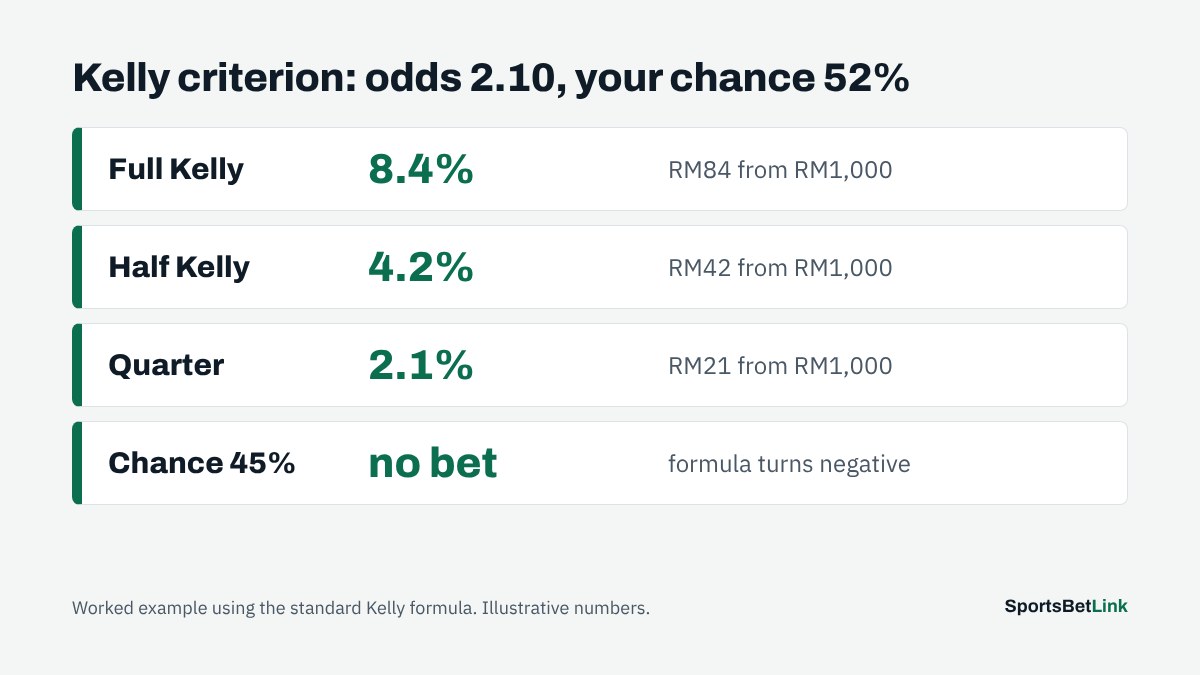
Notice how fast the stake shrinks as your estimate gets closer to the price’s own implied chance. At 2.10 that is about 47.6%; our betting odds guide shows the conversion.
Why most bettors use half or quarter Kelly
Full Kelly assumes your probability is exactly right. It never is. A small overestimate pushes the stake up sharply, and the swings at full Kelly are already large: long losing runs are normal even with a real edge.
Betting a fraction cuts both problems. Half Kelly gives up some growth in exchange for much smaller swings, and quarter Kelly is gentler still. Betting far above Kelly, on the other hand, can wipe out the long-run growth entirely, so the risk is lopsided: it is safer to undershoot than to overshoot.
How to estimate your chance honestly
- Start from the market: convert the best price you can find into an implied chance.
- Adjust only for information you can name, such as a confirmed injury.
- Keep the adjustment small; a few percentage points is a large edge in football.
- Record your estimates and compare them with results over a season.
- If your estimates do not beat the market over time, the formula has nothing to work with.
Kelly criterion for parlays and several bets at once
The simple formula is for one bet at a time. When several bets run together, or legs are combined in a parlay, the chances interact, and staking full Kelly on each one overstates the total risk. Most bettors simply scale every stake down further. Our mix parlay guide explains why parlay risk compounds.
Kelly criterion vs flat staking
| Method | Stake | Best for |
|---|---|---|
| Flat staking | The same amount on every bet | Most bettors, and anyone unsure of their edge |
| Percentage staking | A fixed share, such as 1% to 2% | Keeping stakes in line as the bankroll changes |
| Fractional Kelly | A share that grows with your edge | Bettors with a tested record of estimates |
If you are still building that record, flat or percentage staking is the honest choice. Our football betting tips suggest 1% to 2% of a monthly budget per bet.
Rebates: a small edge Kelly cannot see
Money back on every bet improves your long-run return regardless of the result, which the Kelly formula does not count. Gembet pays sports rebates with no turnover, Crown88’s daily rebate reaches 0.9% and UEA8 shows an instant 1.20% daily rebate.
Kelly criterion: frequently asked questions
What is the Kelly criterion formula?
Stake share = (b x p – q) / b, where b is decimal odds minus 1, p is your chance of winning and q is 1 – p.
Who created the Kelly criterion?
John Kelly of Bell Labs, in a 1956 paper in the Bell System Technical Journal.
What is half Kelly?
Staking half of what the formula suggests, which cuts the swings sharply for a small loss in growth.
What if the Kelly result is negative?
The price offers no edge at your estimate, so the formula says not to bet.
Can I use Kelly without knowing my edge?
Not safely. The formula depends entirely on your probability estimate; without a tested record, use flat stakes.
Does Kelly work for parlays?
The simple formula is for single bets. For parlays and several bets at once, stake well below it.
Bet only what you can afford to lose and set a deposit limit before your first bet. Our responsible gambling guide and the help numbers for Malaysia are there if betting stops being fun.
Sources
- American Scientist: Bettor math (Kelly’s 1956 paper at Bell Labs). www.americanscientist.org
- Gembet home page, promotions and VIP sections. gembet.com
- Crown88 home page. crown88.live
- Crown88 promotions. crown88.live
- Crown88 VIP Club. crown88.live
- UEA8 Malaysia home page. www.uea8.com
- UEA8 promotions page. www.uea8.com